

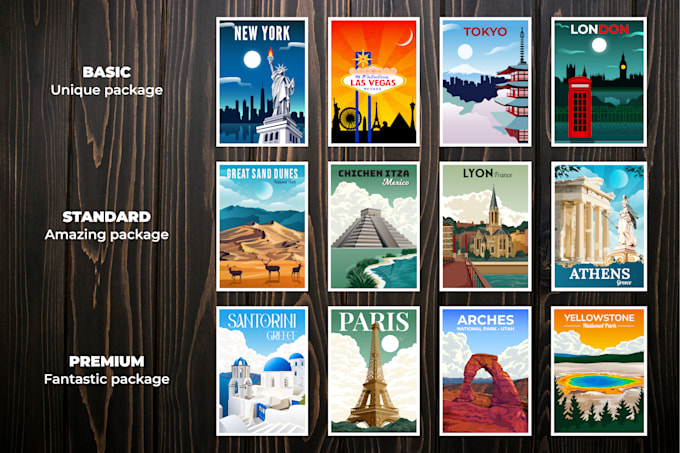
I found my first travel retro poster in a dusty little shop in Lisbon, tucked behind a stack of old postcards nobody seemed to want. It was a print of the Portuguese coast, all bold orange skies and a ship that looked like it belonged in a children’s book. I paid way too much for it, honestly, but I still have it hanging above my desk five years later. And every time I look at it, I remember exactly how the air smelled that afternoon.
That’s the thing about these posters. They’re not just decoration. They pull you somewhere.
What Makes Travel Retro Posters So Different
Modern travel ads are slick. Perfect lighting, perfect models, perfect everything. It’s impressive, sure, but it doesn’t stick with you the same way.
Travel retro posters come from a completely different era of advertising — think 1920s through the 1960s, when airlines, railways, and tourism boards hired actual artists (not photographers, artists) to sell destinations. Flat color blocks. Bold typography. A kind of confident simplicity that feels almost handmade because, well, it was.
There’s a warmth to that imperfection. A hand-painted mountain range doesn’t need to be geographically accurate to make you want to book a flight.
The Colors Do Half the Work
Look at any classic railway poster from that period and you’ll notice something — the color palettes are almost never realistic. Skies go orange when they should be blue. Oceans turn teal instead of navy. It’s not a mistake. It’s mood over accuracy, and it works ridiculously well.
I’ve tried explaining this to friends who collect modern prints and they don’t always get it at first. Then I show them a 1930s Riviera poster next to a current Instagram travel ad, and suddenly they understand exactly what I mean.
A Bit of History Nobody Really Talks About
Here’s something most people don’t know — a lot of these posters weren’t originally meant to be art at all. They were mass-produced marketing tools, printed cheap, plastered in train stations and put up in travel agency windows, then thrown away once the season ended. The ones that survived did so mostly by luck.
That’s part of why original vintage travel posters go for thousands of dollars at auction now. Not because they were treasured at the time — because almost nobody bothered to keep them.
Kind of ironic, right? The stuff nobody valued back then is exactly what collectors are chasing today.
Airlines Started It, Railways Perfected It
Pan Am, TWA, Swissair — these were some of the biggest players pushing this style early on. But if you ask me, European railway companies took it to another level. French and Swiss rail posters from the 30s have this precision to them, almost architectural, yet still warm somehow. There’s a particular one advertising the French Alps I keep thinking about buying a print of, even though I already own three ski-themed posters I don’t have wall space for.
Why People Are Buying These Again
You’d think something this old would feel outdated by now, but it’s kind of the opposite. Walk into any home decor store and you’ll spot reproduction travel posters everywhere — cafes, Airbnbs, apartment walls of people who’ve genuinely never left their home city.
Part of it is nostalgia, even for places we’ve never actually visited. There’s something comforting about that old-world aesthetic. But I think the bigger reason is that these posters tell a story without trying too hard. No slogans screaming at you. No “Book Now” buttons. Just a place, a mood, and enough negative space to let your imagination wander a little.
Also Explore Our Guide On This: Travel Humidor
They Work With Almost Any Interior
I’ve seen them in minimalist Scandinavian apartments. I’ve seen them in cluttered maximalist bedrooms covered floor to ceiling in mismatched frames. Somehow they fit both. Maybe it’s the simplicity of the shapes, maybe it’s just good design aging well — either way, that flexibility is a big reason designers keep coming back to this style for everything from posters to book covers to packaging.
How to Actually Buy One (Without Getting Scammed)
If you’re hunting for an original, be careful. There are a lot of “vintage-style” reprints being sold as authentic, and unless you know what to look for — paper texture, printing method, fold lines, fading patterns — it’s easy to overpay for something that was printed last year.
For most people, though, honestly? A good quality reproduction is the smarter move. You get the same look, the same feeling on your wall, without needing to insure it like a piece of fine art. Plenty of independent artists now create original travel retro posters inspired by that mid-century style, and some of them are genuinely stunning — arguably better composed than a few of the originals I’ve seen in museum archives.
Where to Look
Etsy has a huge range if you know how to filter through the noise. Flea markets abroad are a gamble but sometimes a goldmine — I once found a mint condition Italian coastal print in Porto of all places, no idea how it ended up there. And a few dedicated poster shops in cities like Paris and Barcelona specialize almost entirely in this era of travel art, which is worth a visit even if you’re not buying anything.
Final Thoughts
There’s something almost stubborn about how well this style has held up. Trends in design come and go every few years, but travel retro posters just keep finding new fans, decade after decade. Maybe it’s the colors. Maybe it’s what they represent — a slower, more romantic version of travel that doesn’t really exist anymore, if it ever truly did.
Either way, mine’s staying above my desk. I’m not taking it down anytime soon.
FAQs
Are original travel retro posters worth a lot of money?
It depends heavily on condition, rarity, and the artist. Some sell for under a hundred dollars, others go for thousands at auction. Paper quality and fading matter a lot when it comes to real value.
What’s the difference between a vintage poster and a retro-style poster?
A vintage one was actually printed decades ago. A retro-style poster is new but designed to look like it came from that era. Both can look great, just be honest with yourself about what you’re buying.
Can I use a travel retro poster style for my own design projects?
Absolutely, plenty of designers borrow the flat colors and bold type from this style for menus, book covers, even wedding invitations. It’s a look that translates well beyond just posters.
Where’s the best place to start a collection?
Honestly, just start with one piece you genuinely love, not one you think will be valuable someday. The collecting part sort of happens naturally after that.
Follow Us for More Informational Blogs
