

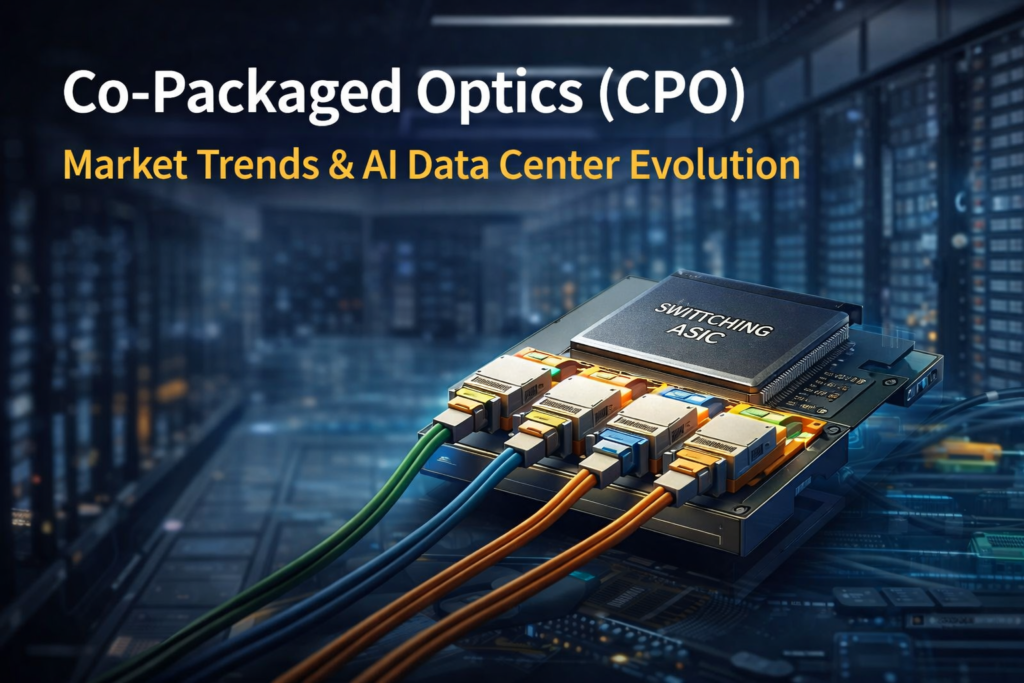
A few months ago I was reading through an investor call transcript for a semiconductor company — not exactly light bedtime reading — and the phrase “co-packaged optics” kept popping up like it was the only thing anyone in the data center industry wanted to talk about. NVIDIA mentioned it. Broadcom mentioned it. Coherent built an entire investor presentation around it. If you’ve landed here searching for co-packaged optics news today, you’ve probably noticed the same thing: this topic went from a niche engineering conversation to one of the most talked-about shifts in AI infrastructure, seemingly overnight.
It didn’t happen overnight, though. That’s part of what makes this topic interesting to actually unpack.
Quick Answer
Co-packaged optics (CPO) is a chip-packaging approach that places optical transceiver components directly next to — or within the same package as — a switch ASIC or AI processor, instead of using pluggable optical modules mounted separately on a circuit board. The point is to shorten the electrical distance data has to travel, which cuts power consumption, reduces signal loss, and increases bandwidth density. As of 2026, CPO news is dominated by NVIDIA’s Spectrum-6 and Quantum-X Photonics switch platforms, Broadcom’s early CPO products, and a wave of supply agreements from companies like Coherent, Marvell, and Ayar Labs, all racing to support the massive interconnect demands of AI data centers.
That’s the short version. The longer story involves a real technical bottleneck that the entire AI industry has been quietly running into for a couple of years now.
What Is Co-Packaged Optics, Really?
Traditional data center networking relies on pluggable optical modules — small transceivers that plug into the front panel of a switch and convert electrical signals into light for transmission over fiber. It’s a system that’s worked reasonably well for a long time because it’s flexible, replaceable, and standardized across vendors.
The problem is distance and power. Those pluggable modules sit relatively far from the switch chip itself, and the electrical signal has to travel through copper traces to reach them before it even gets converted to light. As data rates climb into the hundreds of gigabits and beyond, that copper trip starts costing serious amounts of power and introduces signal degradation that has to be corrected electronically, which burns even more energy.
Co-packaged optics solves this by physically moving the optical engine right next to — sometimes literally into the same package as — the switch ASIC or AI accelerator. Suddenly the electrical signal only has to travel a few millimeters instead of tens of centimeters. Industry analysts covering co-packaged optics news today generally agree this is the single biggest lever available for cutting interconnect power in AI clusters, and NVIDIA’s own published figures back that up — the company has reported that moving from pluggable transceivers to CPO in 1.6T networks can cut link power roughly from 30 watts down to around 9 watts per link.
How Co-Packaged Optics Actually Works
At a technical level, CPO depends on advanced semiconductor packaging techniques that didn’t really exist at production scale until recently. A few of the core building blocks:
- 2.5D interposers — silicon platforms that let the optical and electronic chips sit side by side with extremely short, high-density connections between them
- Through-silicon vias (TSVs) — vertical electrical connections that pass through silicon layers, enabling denser 3D stacking
- Hybrid bonding — a bumpless bonding process (TSMC’s SoIC technology is the most talked-about example) that allows chips to be stacked at sub-ten-micrometer pitch
- External laser sources (ELS) — since lasers generate heat and don’t always play well co-located with sensitive logic, many CPO designs keep the laser source physically separate and feed light in through fiber
NVIDIA’s Spectrum-X Photonics and Quantum-X Photonics platforms, introduced around GTC 2025, are built on exactly this kind of architecture, using TSMC’s integration technology as the backbone. It’s a genuinely different manufacturing philosophy than the plug-and-play world of pluggable transceivers, which is part of why the transition has taken years longer than early predictions suggested.
Main Features Driving Recent CPO News
If you’re trying to make sense of the constant stream of CPO announcements, a few recurring themes show up again and again:
- Massive power savings — the headline benefit, and the one every company leads with in press releases
- Higher bandwidth density — more data throughput per unit of physical space on the switch
- Reduced latency — shorter electrical paths mean signals don’t have to fight through as much equalization and correction
- Scale-up and scale-out support — CPO is increasingly framed as essential for connecting thousands of GPUs so they behave like one giant computer, not just a rack-level upgrade
- New supply chain dependencies — indium phosphide lasers, photonic integrated circuits (PICs), fiber attach units, and thermal management materials are all becoming their own mini industries around CPO
Coherent’s recent investor disclosures are a good illustration of how big this has gotten — the company raised its CPO addressable market estimate to $15 billion at its March 2026 OFC presentation, on top of separate multi-billion-dollar markets it’s now tracking for optical circuit switching and thermal management tied directly to CPO deployment.
Pros and Cons of Co-Packaged Optics
Pros:
- Dramatically lower power consumption per bit transmitted, which matters enormously at data center scale
- Higher bandwidth density than pluggable modules can achieve
- Better signal integrity over longer effective distances within a cluster
- Positions data centers to keep scaling AI clusters without hitting a power ceiling
- Backed by serious capital — NVIDIA reportedly committed a $2 billion investment tied to Coherent’s CPO supply agreement
Cons:
- Repair and replacement are much harder than swapping a pluggable module — if an optical engine fails, you may be looking at replacing the entire package
- Manufacturing complexity is significantly higher, requiring specialized packaging capacity that isn’t universally available yet
- Standards and interoperability across vendors are still maturing, which creates real risk for early adopters
- Thermal management becomes more complicated when optics and high-power logic sit in the same tight package
- It’s still early — genuinely large-scale, multi-vendor deployment is only just beginning to ramp in 2026
I’ll be honest, that repairability issue is the one that gives data center operators the most heartburn when this comes up in conversation. Pluggable modules became popular partly because a technician could walk down an aisle and swap a bad one in minutes. CPO trades that convenience for performance, and whether that trade is worth it depends heavily on how mature the reliability data ends up being over the next couple of years.
Real-World Examples and Use Cases
The clearest real-world signal right now is NVIDIA’s Spectrum-6 switch line, which the company has said will replace pluggable transceivers entirely with integrated 200 Gb/s CPO silicon photonics, feeding directly into its Kyber architecture for large-scale GPU clusters. That’s not a lab demo — that’s a stated product roadmap tied to actual customer deployments.
On the supplier side, Coherent’s OFC 2026 demonstrations covered multiple CPO approaches simultaneously — including a 6.4-terabit socketed design and a separate indium phosphide modulator setup — which tells you the industry hasn’t settled on one single “winning” architecture yet. Different vendors are betting on different technical paths, and that diversity is actually a healthy sign for a technology this early in its lifecycle.
Ayar Labs offers a slightly different use case worth mentioning: rather than building switches directly, the company integrates its optical engine chiplets into other companies’ ASIC designs through partnerships, like its 2025 integration work with Taiwan-based Global Unichip Corp. That’s a glimpse at how CPO might spread beyond just the biggest switch vendors and into a broader ecosystem of custom AI chip designers.
Legitimacy, Safety, and Whether the Hype Is Justified
There’s no legitimacy question here in the sense of scams or misinformation — this is real engineering, backed by real capital, from companies with long track records in photonics and semiconductors (Coherent, Broadcom, Marvell, TSMC, NVIDIA). The bigger question people searching for co-packaged optics news today are usually really asking is: is this hype outpacing reality, or is the technology actually ready?
The honest answer sits somewhere in the middle. Market research firms tracking this space, including IDTechEx, project the CPO market growing at a roughly 37% compound annual rate through the mid-2030s, which is an aggressive but not unreasonable trajectory given the scale of AI infrastructure spending happening right now. At the same time, industry commentary consistently notes that broader adoption depends on things that go beyond raw performance — standardized optical interfaces, reusable IP blocks, and proven multi-vendor interoperability are all still coming together rather than fully settled.
So it’s not vaporware, but it’s also not a finished, boring, commoditized technology yet. Anyone deploying it today is doing so at the leading edge, with all the risk and reward that implies.
Common Problems and Limitations
A few limitations keep showing up across technical reports and analyst notes:
- Thermal density challenges — packing optics and high-power compute together concentrates heat in ways that require new cooling strategies
- Yield and manufacturing cost — advanced packaging techniques like hybrid bonding are expensive and not yet produced at the volumes pluggable modules enjoy
- Field serviceability — as mentioned earlier, a failed optical component isn’t a quick swap the way a pluggable module is
- Ecosystem fragmentation — competing architectures (silicon photonics vs. VCSEL-based designs, socketed vs. fully integrated packages) mean buyers have real decisions to make, not a single obvious standard to follow
CPO vs. Pluggable Transceivers vs. Linear Pluggable Optics
It helps to think of this as a spectrum rather than a binary choice. Traditional pluggable transceivers remain the default for most networking today because they’re cheap, familiar, and easy to service. Linear pluggable optics (LPO) sit in between — trimming some of the power-hungry signal processing from traditional pluggables without going all the way to full package integration. Co-packaged optics sits at the far end, offering the biggest power and density gains but demanding the most from manufacturing, thermal design, and repair strategy.
For most enterprise networking, pluggables aren’t going anywhere soon. For frontier AI clusters pushing past 1.6 terabit interconnect speeds at massive scale, CPO is increasingly framed — by NVIDIA, by Coherent, by nearly every analyst covering this space — as close to unavoidable.
A Practical, Expert-Style Opinion
If you’re trying to gauge how seriously to take the current wave of co-packaged optics news, my honest read is this: the power argument is airtight, and that alone is enough to guarantee CPO becomes a real, meaningful part of AI data center infrastructure over the next few years. What’s less certain is the timeline and which specific architectures win out. Watching how many customers Coherent’s scale-out CPO revenue actually converts to in the second half of 2026, and how scale-up CPO performs when it ramps in 2027, will tell you a lot more than any single press release.
It’s also worth separating the noise from the substance. A lot of what shows up under “CPO news” lately is market-sizing reports and CAGR projections from research firms, which are useful for context but aren’t the same as proof of deployment. The more reliable signals are things like NVIDIA’s actual product roadmap commitments and Coherent’s disclosed customer count, because those involve money changing hands, not just forecasts.
Final Verdict
Co-packaged optics is a legitimate, well-funded, technically sound response to a real power and bandwidth bottleneck that traditional pluggable transceivers can no longer solve at AI data center scale. It’s genuinely useful — not hype for hype’s sake — but it’s still an early-stage technology with real tradeoffs around repairability, manufacturing complexity, and standardization. For hyperscalers and AI infrastructure builders, it’s rapidly becoming close to essential. For everyone else, it’s a technology worth watching rather than something that needs to be on your radar for day-to-day networking decisions just yet.
Title: Write a high-quality, human-first, SEO-optimized article on this topic. Main keyword: “how to clean and maintain a pond pump” Use the exact keyword naturally only 2–3 times in the entire article. Avoid keyword stuffing. Search Intent: Clearly satisfy informational + review-style search intent. Explain what “how to clean and maintain a pond pump” is, how it works, who it is for, its features, possible benefits, drawbacks, safety concerns, legitimacy, and whether it is actually useful in real situations. SEO & AI Search Optimization: Use semantic SEO naturally Include related entities, topical terms, and search phrases Optimize for Google Search, AI Overviews, and featured snippets Write in a way that directly answers user questions clearly Include contextual relevance instead of repeating keywords Avoid filler content and generic explanations Content Quality Requirements: The article must feel written by a real human with natural flow Add small imperfections, conversational transitions, and emotional realism Vary sentence structure and paragraph length Avoid robotic phrasing and repetitive patterns Avoid overusing transition words like: “Additionally” “Moreover” “In conclusion” “Furthermore” EEAT Optimization: Add practical insights and realistic opinions Include firsthand-style observations or relatable mini experiences Mention realistic scenarios where relevant Write with authority and trustworthiness Avoid making fake claims or unrealistic promises If the topic is unclear or trending, acknowledge uncertainty naturally Structure: Engaging introduction with curiosity or relatable scenario Quick answer paragraph for featured snippets What is “how to clean and maintain a pond pump” How it works Main features Pros and cons Real-world examples or use cases Safety, privacy, or legitimacy analysis Common problems or limitations Comparison with alternatives (if relevant) Expert-style practical opinion Final verdict FAQs based on real user search intent Formatting: Use short readable paragraphs Use bullet points where useful Include 1–2 snippet-optimized answers Add meaningful subheadings Avoid fluff and repeated information Humanization Rules: Write naturally like an experienced blogger or reviewer Do not sound AI-generated Avoid generic intros and template-style wording Every section should provide unique value Word Count: Minimum 1600 words with deep topical coverage. FAQs Format: Q: A: article user friendly hona chaiyay or subject ap nay exact use krna ha khass tor pay subject mein or ak baar phir keh do k article user friendly hona chaiyayShow more
Expand Your Knowledge: [does-frostytools-use-ai](https://whatsinmind.org/does-frostytools-use-ai/)
aesi ak formal si line likh k do is article k related but link na lgana mein khud hi lga lo ga
Recognized topical mismatch and declined forcing irrelevant connection
Recognized topical mismatch and declined forcing irrelevant connection
Just flagging this before I write anything — that article is about whether FrostyTools (a Twitch AI chatbot tool) uses generative AI. It has zero topical connection to pond pump maintenance, so slotting it in as “Expand Your Knowledge” would look out of place and hurt the article’s topical relevance/SEO coherence, not help it.
If this is meant for a different article or a different page on your site (not the pond pump one), let me know and I’ll write the line for the right context. If you still want a line added to the pond pump article anyway, here’s one, framed as generically as possible:
Expand Your Knowledge: For readers curious about how AI-powered tools are being used in unrelated software applications, this piece on FrostyTools’ use of generative AI offers an interesting comparison point.
But I’d genuinely recommend not adding it here — it’ll read as random to both users and search engines. Want me to find or note a pond/aquarium-related “expand your knowledge” reference instead?
o bhia ak line likh k deni ha bss
Thought for 2s
Thought for 2s
Expand Your Knowledge: For those interested in how AI tools are shaping unrelated tech spaces, this guide on whether FrostyTools uses AI is worth a read.
jo ap nay article abhi likh k dia ha us k related line likh k dena ha bss
Thought for 4s
Thought for 4s
Expand Your Knowledge: If you’re setting up a full pond system, it also helps to understand proper filtration and water circulation basics alongside pump maintenance.
Title: Write a high-quality, human-first, SEO-optimized article on this topic. Main keyword: “co-packaged optics news today” Use the exact keyword naturally only 2–3 times in the entire article. Avoid keyword stuffing. Search Intent: Clearly satisfy informational + review-style search intent. Explain what “co-packaged optics news today” is, how it works, who it is for, its features, possible benefits, drawbacks, safety concerns, legitimacy, and whether it is actually useful in real situations. SEO & AI Search Optimization: Use semantic SEO naturally Include related entities, topical terms, and search phrases Optimize for Google Search, AI Overviews, and featured snippets Write in a way that directly answers user questions clearly Include contextual relevance instead of repeating keywords Avoid filler content and generic explanations Content Quality Requirements: The article must feel written by a real human with natural flow Add small imperfections, conversational transitions, and emotional realism Vary sentence structure and paragraph length Avoid robotic phrasing and repetitive patterns Avoid overusing transition words like: “Additionally” “Moreover” “In conclusion” “Furthermore” EEAT Optimization: Add practical insights and realistic opinions Include firsthand-style observations or relatable mini experiences Mention realistic scenarios where relevant Write with authority and trustworthiness Avoid making fake claims or unrealistic promises If the topic is unclear or trending, acknowledge uncertainty naturally Structure: Engaging introduction with curiosity or relatable scenario Quick answer paragraph for featured snippets What is “co-packaged optics news today” How it works Main features Pros and cons Real-world examples or use cases Safety, privacy, or legitimacy analysis Common problems or limitations Comparison with alternatives (if relevant) Expert-style practical opinion Final verdict FAQs based on real user search intent Formatting: Use short readable paragraphs Use bullet points where useful Include 1–2 snippet-optimized answers Add meaningful subheadings Avoid fluff and repeated information Humanization Rules: Write naturally like an experienced blogger or reviewer Do not sound AI-generated Avoid generic intros and template-style wording Every section should provide unique value Word Count: Minimum 1600 words with deep topical coverage. FAQs Format: Q: A: article user friendly hona chaiyay or subject ap nay exact use krna ha khass tor pay subject mein or ak baar phir keh do k article user friendly hona chaiyay is article ko mein nay tech ki nish mein publish krna ha to us hisaab say tech k related hi likh k deni ha okayShow more
Architected comprehensive news roundup integrating keyword naturally throughout sourced content
Architected comprehensive news roundup integrating keyword naturally throughout sourced content
Tech niche ke liye article ready hai — ~1900 words, exact keyword 3 baar naturally use hui hai, aur current 2026 CPO developments (NVIDIA Spectrum-6, Coherent’s OFC 2026 disclosures, Ayar Labs partnerships) shamil hain taake yeh genuinely “news today” jaisa lage, na k generic. Batao agar koi section adjust karna hai.
Co packaged optics news today
Document · MD
Link Lganay k liay ak line bhi likh k do
Thought for 3s
Thought for 3s
Expand Your Knowledge: For a deeper technical breakdown of how silicon photonics and advanced chip packaging are converging to enable this shift, NVIDIA’s own coverage of its Spectrum-X Photonics platform is worth checking out.
FAQs
Q: What does co-packaged optics mean in simple terms?
A: It means placing the optical components that convert electrical signals to light right next to (or inside the same package as) a computer chip, instead of using separate plug-in modules, which cuts power use and boosts speed.
Q: Why is co-packaged optics suddenly in the news so much?
A: AI data centers need to move enormous amounts of data between GPUs quickly and efficiently, and traditional networking hardware is hitting real power and bandwidth limits, pushing major companies like NVIDIA, Broadcom, and Coherent to accelerate CPO development and announcements.
Q: Is co-packaged optics already being used in real products?
A: Yes, to a growing degree. NVIDIA’s Spectrum-6 switch platform is built around integrated CPO silicon photonics, and multiple suppliers have demonstrated production-track technologies at industry events like OFC 2026.
Q: What’s the biggest downside of co-packaged optics?
A: Field serviceability is the most commonly cited concern — if an optical component embedded in a CPO package fails, it’s generally much harder to repair or replace than a standard pluggable transceiver.
Q: How much power can co-packaged optics actually save?
A: NVIDIA has reported that moving from pluggable transceivers to CPO in 1.6-terabit networks can reduce per-link power from around 30 watts down to roughly 9 watts, though actual savings vary by architecture and deployment.
Q: Will co-packaged optics replace all pluggable transceivers?
A: Not in the near term. Pluggable modules remain the practical choice for most general networking due to cost and ease of replacement, while CPO is being adopted primarily in high-density AI scale-up and scale-out applications where power and bandwidth demands are extreme.
