

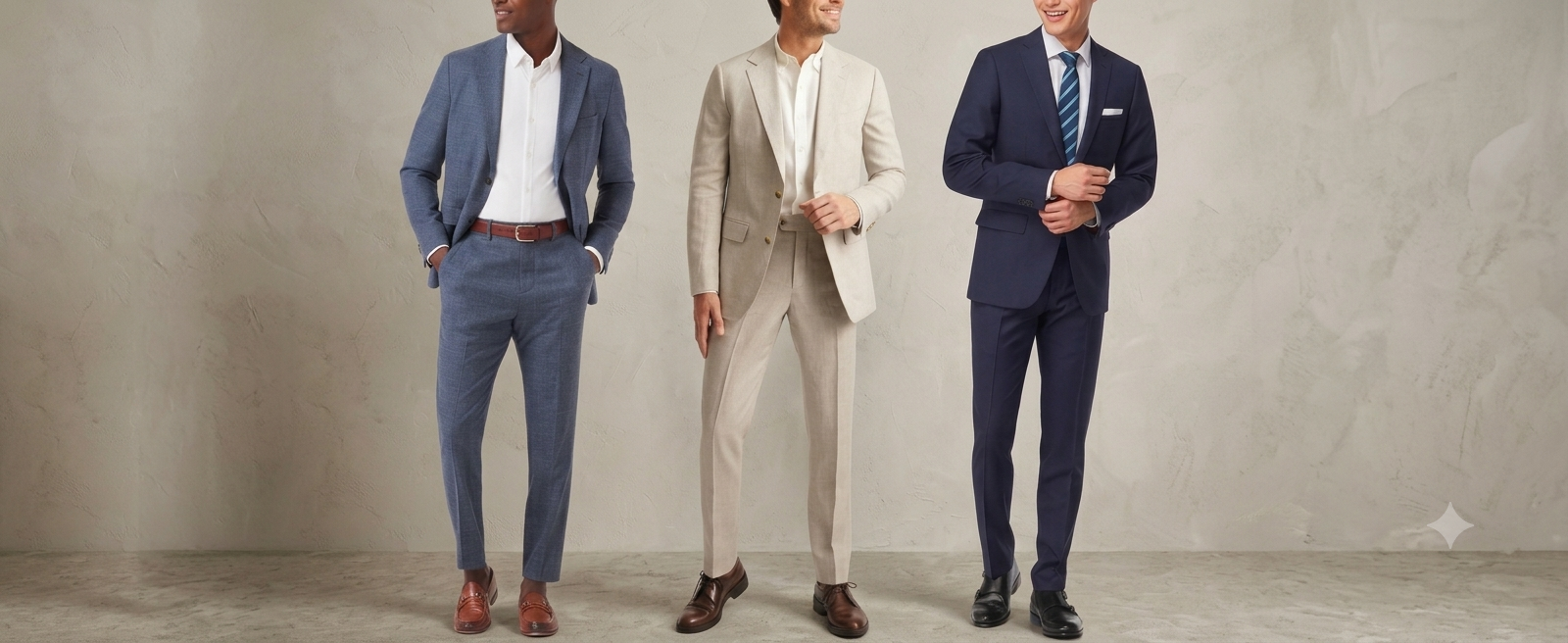
A few years back, I watched a friend walk into a job interview wearing a suit that fit him like it was borrowed from someone two sizes bigger. Smart guy, good résumé, decent answers — but the first impression was already working against him before he opened his mouth. That’s the strange power of a suit. It’s just fabric and stitching, but it talks before you do.
If you’ve landed here, you’re probably trying to figure out what actually makes a good business suit, whether the expensive ones are worth it, or whether you’re overthinking something that should be simple. Fair questions. Let’s get into it properly.
Quick Answer
A business suit for men is a matching jacket-and-trousers (sometimes with a vest) ensemble, typically made from wool, wool-blend, or synthetic fabric, worn in professional and formal settings. The right one fits close at the shoulders, has sleeves that stop near the wrist bone, and trousers that break cleanly over the shoe. Quality, fit, and fabric weight matter far more than brand name or price tag — a $300 suit tailored properly will outperform an $800 suit bought off the rack and left untouched.
What Is a Business Suit, Really?
At its core, a business suit is a coordinated outfit — jacket and trousers cut from the same cloth — designed to look formal, controlled, and put-together. It’s not just “dressy clothes.” It’s a specific category with its own rules around silhouette, fabric, and construction.
Most people lump all suits together, but there’s actually a spectrum here. A two-piece navy suit for client meetings is a different animal than a tuxedo, and both are different from a casual unstructured blazer you’d wear with chinos on a Friday. Business suits for men sit in the middle ground — formal enough for boardrooms, flexible enough to be worn daily without feeling like a costume.
The category typically includes:
- Single-breasted suits (the most common, with one row of buttons)
- Double-breasted suits (two rows of buttons, slightly more formal or fashion-forward)
- Three-piece suits (jacket, trousers, and a matching vest)
How a Business Suit “Works” — Construction and Fit Basics
This is where most buying decisions go wrong, so it’s worth slowing down here.
A suit isn’t just sewn fabric. It has internal structure — canvassing, padding, and lining — that determines how it drapes on your body and how long it’ll hold its shape. There are three main construction types:
Fused suits use glue to bond the canvas to the outer fabric. They’re cheaper to produce and tend to bubble or separate after repeated dry cleaning. Most budget suits under $200 fall here.
Half-canvassed suits use a floating canvas in the chest area, stitched rather than glued, with fusing elsewhere. This is the sweet spot for most buyers — good drape, reasonable price, decent longevity.
Fully canvassed suits are entirely hand-stitched internally, move naturally with the body, and last decades with proper care. This is what you’re paying for at higher price points, and honestly, you can feel the difference the moment you put one on.
Fit-wise, three checkpoints matter more than anything else:
- Shoulders — the jacket seam should sit exactly at the edge of your shoulder bone. This can’t be altered easily, so get it right at purchase.
- Sleeve length — should end right at the wrist bone, showing about half an inch of shirt cuff.
- Trouser break — a slight crease where the trouser meets the shoe, not bunching or dragging.
Main Features to Look For
When comparing options, here’s what actually separates a good suit from a forgettable one:
- Fabric weight — measured in grams or ounces. Lighter (around 240–260 gsm) works for warm climates; heavier (300+ gsm) suits cooler regions and drapes better.
- Natural fibers — wool breathes, holds creases, and ages well. Polyester blends are cheaper and more wrinkle-resistant but look noticeably flatter under light.
- Buttoning stance — two-button jackets are the safest, most universally flattering choice for most body types.
- Lapel style — notch lapels for everyday business wear, peak lapels for a sharper, more formal statement.
- Lining — full lining adds structure and smoothness; half-lining is cooler but shows more wear over time.
Pros and Cons
No honest review skips this part.
Pros:
- Instantly elevates perceived professionalism and credibility in meetings, interviews, and client-facing roles
- Versatile — one well-fitted navy or charcoal suit can be restyled with different shirts and ties for weeks
- Durable when properly constructed; a good wool suit can last 8–10 years with rotation and care
- Builds confidence in a way that’s honestly hard to quantify but easy to notice once you’ve experienced it
Cons:
- Quality suits require real investment, both in purchase price and tailoring costs
- Wool suits need dry cleaning and proper storage, which adds ongoing maintenance
- Ill-fitting suits — even expensive ones — can look worse than a cheap, well-tailored alternative
- Sizing across brands is inconsistent, making online buying genuinely risky without a return policy
Real-World Scenarios Where This Actually Matters
I think examples explain this better than specs ever could.
A consultant I know wears the same three suits on rotation — navy, charcoal, and a mid-grey — because client perception research at his firm literally showed measurable differences in trust ratings based on attire consistency. Sounds dramatic, but it tracks with what most people intuitively feel.
On the flip side, a recent grad I spoke with bought a flashy slim-fit suit for his first interview round, not realizing the company culture leaned business-casual. He felt overdressed and self-conscious the entire meeting — a reminder that “good suit” also means “right suit for the room.”
Then there’s the wedding-guest scenario, which technically overlaps with business suits since many men reuse their work suit for formal events. It works fine for daytime weddings but can look slightly mismatched for black-tie evening affairs, where a tuxedo or darker formalwear is expected.
Is It Safe, Legitimate, and Worth Buying Online?
This question comes up a lot, especially with the explosion of direct-to-consumer suit brands.
Legitimacy isn’t usually the issue — most established suit retailers, whether physical stores or known online brands, are perfectly safe to buy from. The real concerns are:
- Sizing accuracy, especially with overseas manufacturers using different measurement standards
- Return and alteration policies, which vary wildly and should be checked before purchase
- Fabric misrepresentation, where “wool blend” sometimes means a fabric that’s mostly polyester with a small wool percentage
A practical safety tip: always check the fabric composition tag, not just the marketing copy. And if buying online, confirm whether the brand offers free alterations or a tailoring credit, since almost no suit fits perfectly off the rack.
Common Problems and Limitations
Even good suits run into predictable issues:
- Shoulder pads that shift or “divot” over time with cheaper construction
- Trousers that fit at purchase but change after a few dry cleans due to shrinkage
- Jackets that look great standing but pull or wrinkle when sitting for long meetings
- Seasonal mismatch — wearing a heavy wool suit in humid climates leads to visible sweating through fabric
None of these are dealbreakers, but they’re worth knowing upfront so you’re not caught off guard.
Suits vs. Alternatives — Blazers, Separates, and Smart-Casual Sets
It’s worth comparing business suits against the alternatives gaining popularity, since not every workplace requires full formal wear anymore.
Blazer-and-trouser separates offer more flexibility in mixing colors and textures, and they’re forgiving if your top and bottom half are different sizes. They read slightly less formal than a true matching suit, though.
Smart-casual sets (unstructured jackets, chinos) work in creative industries or startups but fall short in traditional corporate, legal, or finance settings where a structured suit remains the expectation.
Honestly, if your workplace is genuinely business-casual, you don’t need a closet full of suits — two solid ones (navy and charcoal) cover 90% of situations, supplemented by separates for everything else.
A Practical, Experience-Based Opinion
Here’s where I’ll be direct: most men over-research the brand and under-research the fit. I’ve seen $150 suits, properly tailored, look sharper than $900 suits worn straight off the rack. Tailoring is the variable people skip, and it’s the one that matters most.
If you’re buying your first suit, spend your budget like this: 60% on a decent base suit (half-canvassed if possible), 25% on tailoring, 15% reserved for a second suit or accessories. That allocation consistently produces better results than blowing the whole budget on one “premium” piece and wearing it unaltered.
Final Verdict
A well-chosen business suit remains one of the most reliable tools for projecting professionalism, and it’s not going out of style anytime soon despite the rise of casual workplaces. The key isn’t finding the “best” suit — it’s finding the right fit, fabric, and fit-for-purpose match for your actual job and climate. Skip the assumption that price equals quality, and don’t skip tailoring under any circumstance.
Explore More Articles: kentucky-derby-fashion
FAQs
Q: How much should a good business suit cost?
A: Entry-level quality starts around $200–$350 for half-canvassed construction. Add $50–$150 for tailoring. Suits under $150 are usually fused construction and won’t hold shape as well long-term.
Q: How many business suits does a man actually need?
A: For most office jobs, two is enough to start — one navy, one charcoal or grey. Add a third (black or patterned) once you’re attending more formal events or client meetings regularly.
Q: Can I wear the same suit every week?
A: Yes, if you rotate it with at least one other suit and let each one rest 24–48 hours between wears. Constant wear without rest breaks down fabric fibers faster.
Q: Is buying a suit online safe?
A: Generally yes from established retailers, but always check the return policy and fabric composition before purchasing, since fit issues are the most common online buying problem.
Q: What’s the difference between a suit and a blazer set?
A: A suit’s jacket and trousers are cut from identical fabric and meant to match exactly. A blazer is typically standalone and can be paired with non-matching trousers for a slightly less formal look.
Q: Do business suits still matter in a remote-work world?
A: For client-facing roles, interviews, and formal industries (law, finance, consulting), yes — significantly. For fully remote or casual-culture companies, suits are now more occasional than daily wear.
